The City is building a financing district.
Why? What does it mean? What does it do? What's the benefit — and what's the risk?
Four questions, answered in order, using the City's own numbers. In short: the district captures a slice of future property tax growth along the main corridors and spends it on public infrastructure. No new tax. No rate change. Schools untouched. It is small for a decade, it costs real money to set up and run, and its biggest single benefit depends on Sonoma County agreeing to something it has not yet agreed to.
Council funded formation — not the district itself
On August 4, 2026 the Council approved an agreement with Kosmont Companies to carry the EIFD through the rest of the formation process — and both boundary add-ons with it: one to re-examine growth areas inside the city limits, and one to evaluate whether land outside the city limits should be brought in before the boundary is fixed.
That distinction matters. The district does not exist yet. What exists is a funded, scheduled process with a defined end: confirm whether Sonoma County will match the City's contribution, draft the Infrastructure Financing Plan, hold the statutory hearings, and — if nothing derails it — form the district. Kosmont's schedule puts the district operational in mid-to-late 2027.
The single largest open variable is the County. Confirming the match is Task 1 of the engagement, and Kosmont's own feasibility finding is that the City should proceed only under a scenario where the County matches dollar for dollar. No County agreement exists today.
| Component | Cost | Status |
|---|---|---|
| Kosmont formation advisory (Tasks 1–3) | $40,000 not-to-exceed | Approved Aug 4, 2026 |
| Add-On 1 (Task 4) — re-examine growth areas inside city limits | $10,000 – $15,000 | Approved Aug 4, 2026 |
| Add-On 2 — evaluate areas outside city limits | $20,000 | Approved Aug 4, 2026 |
| Surveying and mapping | $30,000 – $35,000 | Separate agreement, not yet commenced |
| Kosmont contract ceiling, as approved | $70,000 – $75,000 | — |
| Total potential project cost, including surveying | $100,000 – $110,000 | — |
The adopted FY 2026-27 City budget carries $75,000 for EIFD work, which covers the Kosmont contract at its approved ceiling but not the separate surveying and mapping agreement. Kosmont invoices monthly at hourly rates plus a 4% administrative services fee. Staff effort through formation is estimated at 8–10 hours per week. Formation costs are expected to be reimbursable from district revenue once the district is generating increment — but only if it forms and only once revenue exists.
How it actually works, step by step
If you remember one thing: the district never takes a dollar anyone is collecting today. It takes a share of dollars that do not exist yet.
Somebody draws a line on a map
A boundary is set. Inside it, every property's assessed value on formation day is added up and written down. That total is the baseline. It is a starting line, not a claim on anything.
Everything at the baseline keeps flowing exactly where it flows today
Police, fire, county services, schools, special districts — all of it continues, untouched, for the entire 50-year life of the district. The district has no claim on the baseline. Ever.
Property values rise. The extra tax collected is the "increment"
Values go up for three ordinary reasons: California's Proposition 13 adds roughly 2% a year automatically, homes and businesses change hands and get reassessed, and new buildings get built. The tax collected on all that growth, above the baseline, is the increment.
Your rate never changes. It is the same 1% either way. What changes is where a slice of the growth goes.
The City and the County each agree to hand over part of their own slice
Of every property tax dollar collected inside the corridor, the City gets about 14 cents plus another 6 cents' worth in vehicle-license-fee replacement — about 20 cents in all. Sonoma County gets about 22 cents. Schools and other agencies get the remaining 64 cents, and state law flatly forbids them from participating.
Under the scenario studied, the City hands the district 25% of its own share of the growth — and keeps 75%. The County is asked to match the City dollar for dollar, which works out to roughly 23% of the County's share.
That money can be spent as it arrives, or borrowed against
The district can pay cash as revenue accrues, or pledge the revenue stream to repay bonds and build sooner. Bonds issued by the district are repaid only from district revenue. They are not obligations of the City General Fund unless the City separately chooses to pledge it.
After 50 years it ends, and 100% of the money comes back
The district terminates. Every dollar of property tax inside the old boundary — including all the growth the district helped create — flows to the City and County general funds with no deduction at all. This is a lease on a portion of growth, not a sale.
One property tax dollar inside the corridor
Only the City and the County can put money into an EIFD, and only out of their own portions. Between them they control 36 cents of the dollar. The other 64 cents is legally off limits.
- City of Sebastopol ~14¢
- County of Sonoma ~22¢
- Schools & other agencies cannot participate ~64¢
- Plus, to the City: vehicle licence fee replacement +~6¢
The vehicle licence fee replacement is an additional payment measured against property tax, not a slice of the dollar — which is why the City's participating share works out to 20.26% rather than 14%. The County also receives a similar payment, but Kosmont left it out of the model to stay conservative.
And here is the whole thing on one line
The most useful number for judging scale is what the district actually collects per million dollars of new value:
$1,000,000 of new assessed value
  ×  1% property tax levy            =  $10,000
  ×  20.26% City share               =   $2,026
  ×  25% City participation          =     $507   per year to the district
  +  County dollar-for-dollar match  =   $1,013   per year to the district
That is roughly one tenth of one percent of new assessed value per year. Substantial new development produces modest annual revenue. The instrument works by accumulating it over a very long period — which is the whole reason the timing question below matters so much.
Drag the slider to see what is inside the district
The corridor-focused line follows Gravenstein Highway, Healdsburg Avenue, Bodega Avenue and Sebastopol Avenue. Everything dimmed is outside it, and nothing outside it contributes anything or is affected in any way. This line is not final — it is expected to grow, and the money Council approved on August 4 is partly there to work out by how much.
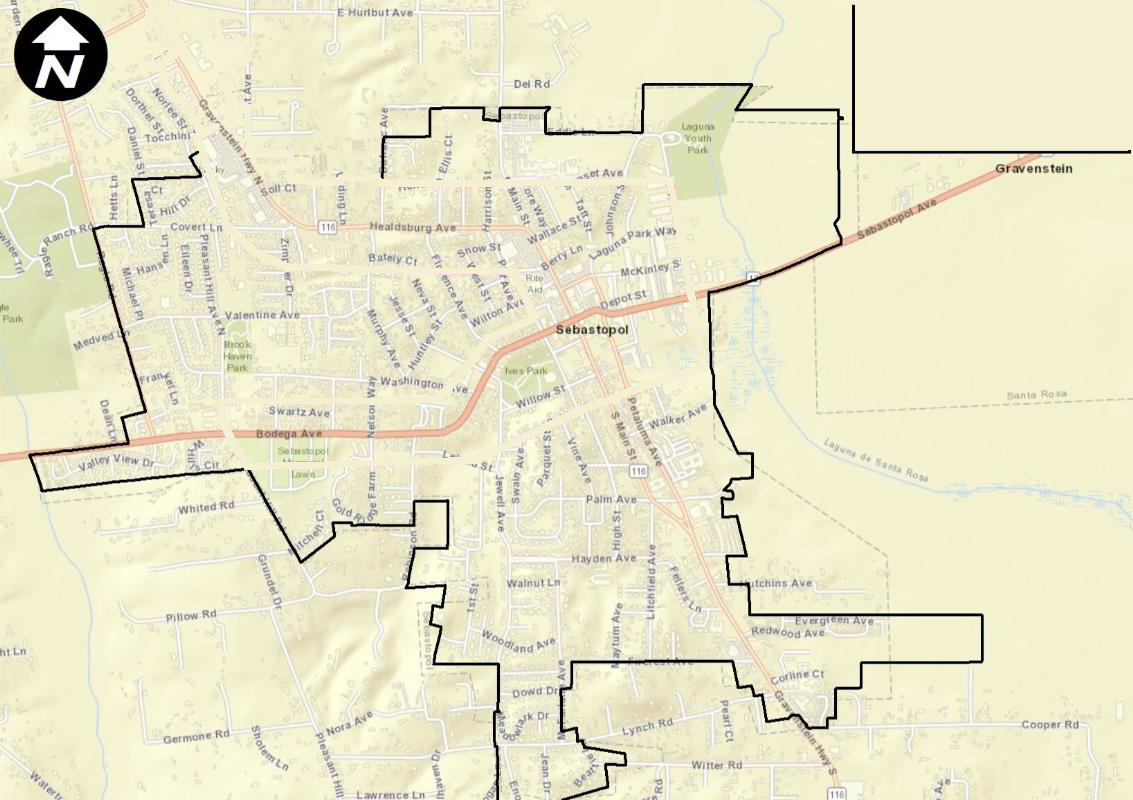
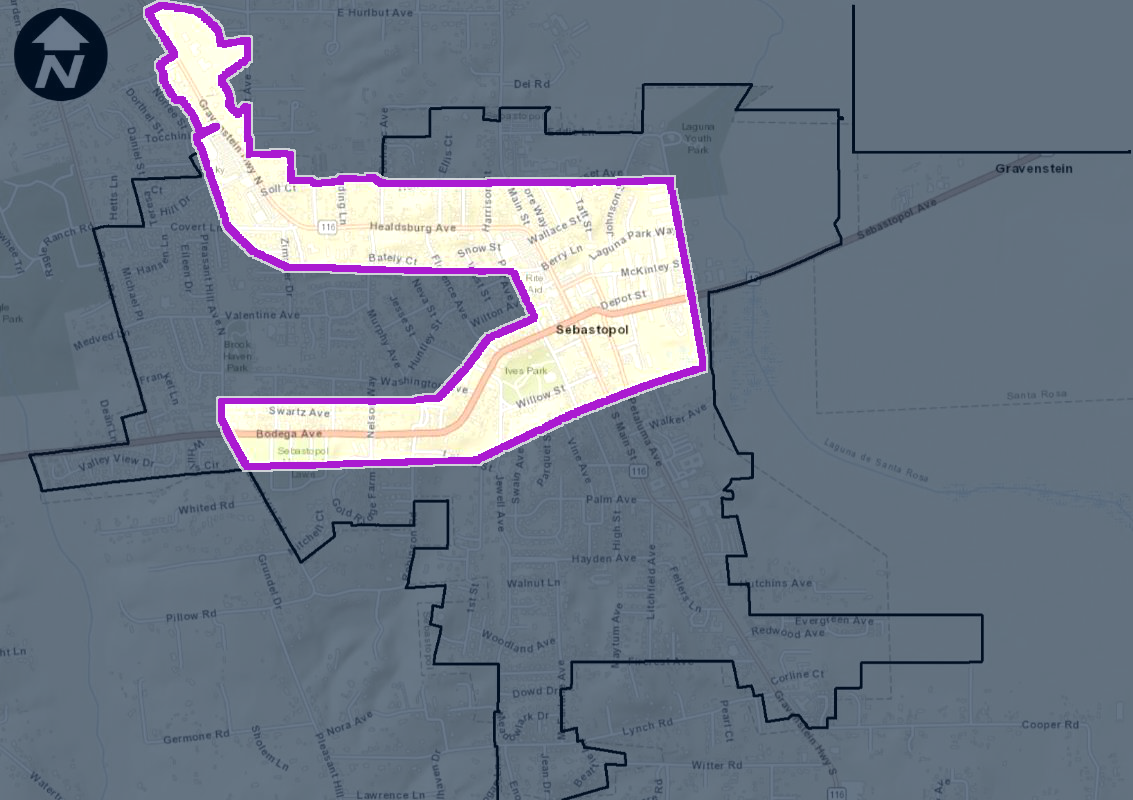
Map adapted from Exhibit A to Resolution No. 6722-2025, the Resolution of Intention adopted December 2, 2025. Boundary data: Parcel Quest, ArcGIS and Kosmont Companies, 2024. The surrounding area is dimmed for legibility; the purple line is the published boundary.
The line above was drawn from 2024 parcel data and reflects the development that was known about then. Two years on, that is already out of date — and the boundary drawn at formation is the boundary the district lives with for fifty years.
Under EIFD law, adding territory after formation means amending the Infrastructure Financing Plan and repeating the entire noticing and hearing sequence — effectively restarting a multi-year process. Changing the line is cheap and fast now, and never again. That window closes when the plan is finalised.
This is exactly what the two add-ons approved on August 4 pay for. One ($10,000–$15,000) re-examines growth areas inside the city limits — parcels where development is now planned or reasonably foreseeable but which fall outside the 2024 line. The other ($20,000) looks outside the city limits: the staff report names areas toward Bloomfield Road and the Flea Market as examples, and the parcels across Gravenstein Highway from the O'Reilly site are another candidate. Council bought the ability to redraw in both directions.
Two constraints on that. Bringing in unincorporated County territory requires a vote of the County Board of Supervisors, and the Board is likely to want its own financial analysis of the added area first — which takes time. And every parcel added at formation enlarges the base on which all future increment is calculated, for the entire life of the district. How much that is worth depends entirely on what actually gets built there, which is why Kosmont's analysis should produce that number rather than anyone estimating it in advance.
What the City puts in, what the County adds, and what builds up
These are Kosmont's published year-by-year figures for the corridor boundary under the scenario the City is pursuing: 25% City participation with a County dollar match. Drag the year slider.
Money into the district, year by year
Kosmont published annual detail through Year 10 only. Year 1 begins the fiscal year after formation.
Revenue in the first three years is negligible — under $140,000 combined per year. Growth then flattens after Year 5, once the assumed wave of new development has been absorbed and increases revert to ordinary assessed-value appreciation. Anyone planning around this instrument has to plan around that curve, not around the fifty-year total.
What that adds up to — and what the County match changes
Accumulated revenue plus the ability to borrow against it. The right-hand column is the scenario the City is pursuing; the left is the same district with the City acting alone.
| Accumulated revenue + bonding capacity | City 25% alone Scenario A |
City 25% + County match Scenario C — the target |
|---|---|---|
| By Year 5 | $689,000 | $2,041,000 |
| By Year 10 | $2,087,000 | $4,837,000 |
| 50 years, present value @ 3% | $10,702,000 | $21,404,000 |
| 50 years, nominal total | $28,185,000 | $56,370,000 |
The match is what moves this from marginal to useful inside the first decade. It is also the only component that brings dollars into Sebastopol that would not otherwise be spent here — County property tax growth inside the boundary would otherwise be budgeted county-wide. Over fifty years the County's side is modelled at $28,184,897 nominal, $10,702,005 in present value.
It recovers nothing already collected — no past revenue comes back to the City. It does not reduce the County's baseline revenue; the County keeps everything it collects today plus roughly 77% of future growth inside the district. And relative to what the County collects from Sebastopol property overall it is modest — by derived estimate, about 4% at Year 10.
The County has not agreed to any of it. Securing that agreement is the first deliverable of the work Council just funded.
Bonding assumptions as published by Kosmont: first issuance in Year 5, $25,000 annual administrative charge, 150% debt service coverage, 6.0% interest, 30-year term, proceeds net of a 2% underwriter's discount, a reserve fund, and issuance costs estimated at $350,000. Present values discounted at 3%. Revenue projections assume approximately $113.7 million of new development absorbed over five to ten years — 12 rental units, 106 for-sale units, 134 affordable units (property-tax exempt, contributing nothing), and 147 hotel rooms.
What does it cost to run this thing?
A financing district is a small government entity. It has a board, a plan, filings, an annual report, and — if it issues debt — continuing disclosure obligations. All of that costs money, and the money comes out of the same increment that pays for the infrastructure.
| Cost | Amount | Who pays, and when |
|---|---|---|
| One-time formation | $100,000 – $110,000 all options incl. surveying |
City General Fund up front. Expected to be reimbursable from district revenue once the district generates increment — conditional on the district actually forming. |
| City staff time through formation | ~8–10 hrs/week | Absorbed by existing staff at project-manager level. Real, and not in any of the dollar figures above. |
| Ongoing district administration | $25,000 / year | Netted out of district revenue before anything is spent or bonded. This is Kosmont's own modelling assumption. |
| Bond issuance, if and when it happens | $350,000 + 2% discount | Paid from bond proceeds — the district borrows slightly more than it nets. Plus a funded reserve and 150% coverage, both of which reduce how much reaches actual projects. |
| Annual report, hearings, continuing disclosure | Not yet priced | Explicitly outside the current Kosmont scope, listed as a future service. Any district debt financing also requires a separately compensated municipal advisor engagement. |
Is the overhead heavy or light? Both — it depends entirely on when you look
In Year 1 the fixed administrative charge consumes roughly 57% of everything the district collects. By Year 5 it is about 10%. By Year 10, about 7%. Across the full fifty years, $25,000 a year against $56.4 million of nominal revenue is roughly 2% — and the one-time formation cost is under a quarter of one percent of the same total.
So the honest answer to "is management expensive?" is: yes at the start, and then it stops mattering. The overhead is a fixed cost sitting on top of a revenue stream that starts near zero. That is an argument for forming the district and then leaving it alone to accumulate — not for treating the early years as a funding source.
It is also an argument for honesty about the first bond. Issuance costs of $350,000 plus a 2% underwriter's discount, a funded reserve, and 150% debt service coverage all sit between the revenue and the concrete. Kosmont's Year 5 capacity figure of $2.04 million is already net of those costs — but it means the district cannot productively borrow small amounts.
Why commit tomorrow's growth to infrastructure today
There are three reasons, and they are not equally solid. I want to separate them clearly, because the strongest argument for this is a boring one and the most exciting argument for it is the one nobody can prove.
Reason one: waiting is not free — and it is not reversible
The baseline is frozen on the day the district forms. Every dollar of value growth that happens before that day gets locked into the baseline permanently, where the district can never touch it. Growth that happens after is capturable for fifty years.
This is the cleanest, least arguable point on this page. Delay does not preserve options. It silently converts capturable growth into permanently uncapturable baseline, and there is no later action that recovers it. A year of delay is a year of capture removed from the far end of a fifty-year instrument.
Reason two: operating money is never going to fund capital here
The City adopted a $16.5 million budget for FY 2026-27 with a deficit of roughly $850,000, and the five-year forecast projects a continuing structural imbalance. In that environment the General Fund will not accumulate capital. It cannot; it is being used to keep services running.
If infrastructure is going to be funded at all, it needs a source that is separate from the operating budget, that grows on its own, and that cannot be quietly reallocated to close next year's gap. That is a genuine structural argument, and it does not depend on any forecast being right.
Reason three: the amplification — real, and unprovable
The theory is a loop. Public infrastructure makes a place more attractive to build in. Building raises assessed value. Higher assessed value produces more increment. More increment funds more infrastructure. And when the district ends, the City and County inherit a permanently larger tax base than they would otherwise have had.
Kosmont puts numbers on this loop. Over fifty years they model a positive net fiscal impact of $19,066,900 in present value to the City and $2,103,100 to the County, net of the contributions — plus roughly 135 permanent jobs with $7.9 million in related wages, and 1,033 construction job-years with $87.5 million in wages.
That entire fiscal benefit rests on one assumption stated in Kosmont's own materials: that the district accelerates development which would otherwise happen later. Their own comparison chart labels the no-district case "slightly delayed investment" — not absent investment.
Nobody can measure that. There is no experiment. We will never run Sebastopol twice and compare. If development timing turns out to be unaffected by the district, the effect on the General Fund is simply the contribution itself — the orange bars in the chart below — and the $19 million evaporates.
The contribution is certain. The amplification is a belief. It happens to be a belief with a reasonable amount of evidence behind it from other cities, and it is the actual reason to do this. But it should be argued as a judgement call, not presented as a projection, and anyone telling you the district "pays for itself" is skipping that step.
What can this do that we could not do before?
Five things, in rough order of how much they actually matter — followed by the things it plainly cannot do.
1. It is the only way County money gets spent here
There is no other mechanism by which Sonoma County co-invests in Sebastopol infrastructure as a standing commitment. Not a grant cycle, not a bond. A match is a fifty-year share of growth — $28.2 million nominal, $10.7 million present value, if agreed.
2. Capital without an election and without a rate increase
General obligation bonds need two-thirds voter approval and are repaid by adding a levy to property tax bills. This needs neither. That is not a small procedural difference — it is the difference between a project that is possible and one that is not.
3. It does not consume the City's borrowing capacity
District debt sits outside the City's general credit profile. Conventional borrowing counts against practical debt capacity; this does not. The City keeps its balance sheet free for whatever else comes.
4. It manufactures local match for outside money
Most state and federal infrastructure programmes require a local contribution the City currently struggles to produce. A district generates exactly that. State programmes also score joint city-county districts higher — likely helpful, not guaranteed.
5. It outlasts any of us
The commitment attaches to a boundary and a filed plan, for up to 45 years from the first bond issuance. It does not need to be re-won every budget cycle or survive every future council majority.
What it cannot do
In its first decade this is a two to five million dollar instrument. It is suited to supplementing, matching and gap-filling. It is not sufficient on its own to fund a major civic facility, and it delivers nothing meaningful before about Year 5.
The categories the district may legally fund are broad and set by statute: streets, bridges, sidewalks and streetscape, bicycle lanes, parking and transit, parks and recreation, libraries, child care facilities, water and sewer, flood control and drainage, broadband, police and fire facilities, brownfield remediation, affordable housing, public art, and climate adaptation. Any project must have a useful life of at least fifteen years. Nothing on this page commits the district to any particular project — that choice belongs to the Infrastructure Financing Plan and the public hearings on it.
Against the alternatives — including what each costs to manage
These are not strict substitutes. A bond delivers capital immediately, in an amount sized to the project. A financing district delivers less, more slowly — but on terms nothing else offers.
| EIFD | Bank loan / private placement | General obligation bond | Lease revenue bond / COP | |
|---|---|---|---|---|
| Voter approval | None | None | Two-thirds required | None |
| Effect on tax rates | None — redirects future growth only | None | Adds a levy to property tax bills | None |
| Who repays it | District increment only, inside the boundary | City General Fund | Property owners, via the added levy | City General Fund |
| Risk to the General Fund | None unless the City separately pledges it | Direct | None — falls on property owners | Direct |
| Effect on City credit | Outside the City's general credit profile | Counts against practical debt capacity | Counts against debt capacity | Counts against debt capacity |
| If growth underperforms | The contribution falls with revenue | Payment stays fixed | Levy adjusts to cover debt service | Payment stays fixed |
| Speed to capital | Slow — meaningful capacity around Year 5 | Fast | Slow — needs an election | Fast |
| Amount available | $2M–$5M in the first decade | Sized to project need | Sized to project need | Sized to project need |
| County co-investment | Yes — dollar-for-dollar match possible | No mechanism | No mechanism | No mechanism |
| State grant scoring | Joint city-county districts score higher | No effect | No effect | No effect |
| Set-up cost | $100k–$110k formation, likely reimbursable from increment | Legal and municipal advisor fees; no public offering costs | Election costs, plus bond counsel and underwriting | Bond counsel, trustee, underwriting |
| Ongoing cost to manage | $25,000/yr modelled, plus annual report and hearings; continuing disclosure if it issues debt | Loan servicing and covenant compliance — the lightest of the four | Trustee, continuing disclosure, and annual administration of the levy | Trustee, continuing disclosure, lease administration |
| Governance overhead | A separate public board with its own meetings, noticing and ethics obligations | None — the City is the borrower | None beyond normal City process | A financing authority, but typically nominal |
Borrowing is faster, bigger and simpler to administer, and every dollar of it is repaid by Sebastopol out of money we already have. The district is slower, smaller and fiddlier to run — and it is the only one of the four that can bring in someone else's money, cannot damage the General Fund if it underperforms, and hands the whole tax base back at the end.
They are also not mutually exclusive. The most likely real use of this district is as the local-match and gap-filling layer underneath a conventional financing, not as a replacement for one.
The EIFD and conventional-bond columns follow the comparison in the August 4, 2026 staff report. The bank loan and lease-revenue columns describe the structural features of those instruments; actual pricing for either would require the City's registered municipal advisor to run a direct solicitation, and no such solicitation has been run.
Is the General Fund safe?
The City's contribution is foregone revenue — money the General Fund would otherwise receive. It never appears as a line-item expenditure, which is exactly why it deserves more scrutiny than an expenditure would get, not less.
What actually leaves the General Fund
The City keeps 100% of the base and 75% of growth inside the boundary. Only the orange leaves.
And here is that against the size of the budget
Both figures would grow over the intervening decade, so treat that as a scale reference rather than a forecast. The point is the order of magnitude: at its tenth-year peak the contribution is roughly one percent of the operating budget, and in the early years — when budget pressure is worst — it is a rounding error.
Four structural protections, and one real exposure
The base is never touched
Every dollar the General Fund collects today keeps flowing, for the entire fifty years. The district has a claim on growth only. There is no scenario in which City revenue falls below what it is now because of this.
It self-corrects in a downturn
The contribution is a percentage of increment, not a fixed payment. If values stall, the contribution stalls with them. This is the opposite of a bond, where debt service is due whatever happens to the economy.
District debt is not City debt
Bonds issued by the district are repaid only from district revenue and are not obligations of the City General Fund — unless the City separately and deliberately chooses to pledge it. That choice would be its own public decision.
Schools are protected by statute
School districts and community colleges cannot participate in an EIFD under California law. Not a local policy choice that a future board could reverse — a statutory bar.
The real exposure: pledged funds lock
Once dollars are pledged to a district obligation such as a bond issuance, they are committed and no longer available to the General Fund. Flexibility is preserved right up until the first bond — and lost at it. That decision, not this one, is the point of no return.
And the honest counter-argument
General Fund dollars are unrestricted — salaries, public safety, operations. District dollars are restricted to capital with a fifteen-year useful life. This trades unrestricted operating money for a larger quantity of restricted capital money. If the more pressing need turns out to be operating funds, the trade works against it.
Through Year 5 the City forgoes approximately $349,958 in cumulative General Fund revenue, against district capacity of approximately $2,041,000 — about 5.8 times. Through Year 10, roughly $1,159,324 forgone against $4,837,000 — about 4.2 times.
The multiplier is real, and it comes from exactly two places: the County match doubling each City dollar, and the ability to borrow against the combined stream. It is not a like-for-like comparison, and whether it is a good trade depends entirely on whether the City has capital needs it cannot otherwise fund.
Where this comes from, and where it has been done
Tax increment financing is not new in California. It was the primary tool of local economic development here for six decades before the state abolished it — and EIFDs are the deliberately narrower instrument the legislature built to replace it.
Redevelopment agencies
California cities funded infrastructure and housing through redevelopment agencies using tax increment. Sebastopol had one — the Community Development Agency. The tool was powerful, widely used, and increasingly criticised for capturing school revenue and for weak accountability.
The state abolished all 400 of them
Facing a budget crisis, the legislature passed ABx1 26. The California Supreme Court upheld it in December 2011 and every redevelopment agency in the state was dissolved effective February 1, 2012. Sebastopol's successor agency has since received a finding of completion and no longer exists. Cities lost their only tax increment tool overnight.
SB 628 created EIFDs
A deliberately constrained successor: no school funding, participation is voluntary for each taxing entity, projects must have a fifteen-year useful life, and formation requires public hearings with majority-protest termination. Less power than redevelopment, and much less collateral damage.
Roughly two dozen districts statewide
Formed EIFDs now include Atwater, Benicia, Beaumont, Carson, Coachella, Garden Grove, Grand Terrace, La Verne, Los Angeles, Ontario, Placentia, Redlands, Rialto, San Bernardino, San Diego (Otay Mesa), San Jacinto, Santa Ana, Santa Fe Springs, West Covina, West Sacramento and Yucaipa. It is an established, if still young, instrument.
Sebastopol funds formation
Council approves the Kosmont formation advisory agreement and the add-on to evaluate areas outside city limits. The district would be the second city-county financing district in Sonoma County, and the first in West County within a city.
Four places worth looking at
West Sacramento
Formed its EIFD in 2016 covering about a quarter of the city. In July 2025 it became the first EIFD in California to issue bonds — $57,225,000 of tax increment bonds — funding transportation, public facilities and the conversion of industrial land to mixed use. Nine years from formation to bond issuance.
Placentia, Orange County
Formed in partnership with the County of Orange around a future Metrolink station, Old Town, and a transit-oriented district. Structurally the closest analogue to what Sebastopol is asking Sonoma County to do.
La Verne, Los Angeles County
A district around a future light rail station targeting fourteen specific projects, redirecting roughly $33 million of increment. A demonstration that a modest, tightly-drawn district can still assemble a real programme.
Santa Rosa
Sonoma County's only existing city-county district. The City committed 50% of its share (~$52.7M) and the County 25% (~$30.0M) — about $0.57 of County money per City dollar. Santa Rosa adopted its resolution of intention in April 2023 and its financing plan was still being revised in early 2026. These processes take years.
First, the deal Sebastopol is seeking — a full dollar-for-dollar match — is more favourable per City dollar than what Santa Rosa obtained. That is a good negotiating position and also a reason for realism about whether the County will agree to it.
Second, Sonoma County adopted its own separate Resolution of Intention for an unincorporated West County EIFD in October 2025. That district proceeds independently and has no effect on the City's. It does mean the County has already chosen not to form a joint district with Sebastopol — its only role here is the funding match.
From here to a district
| When | What happens |
|---|---|
| Aug 2026 | Council approves the agreement. Task 1 begins: County and stakeholder outreach to confirm the partnership. |
| Sep – Nov 2026 | Secure a County participation commitment. Confirm the Public Financing Authority board membership if the County joins. Begin preliminary work on the financing plan. |
| Nov 2026 – Jan 2027 | Draft the Infrastructure Financing Plan — legal boundary description, project list, tax increment projections, fiscal impact analysis. Distribute it to every property owner inside the boundary and to affected taxing entities. |
| Feb – Apr 2027 | Public meetings and hearings. First PFA meeting at least 40 days after distribution; further hearings at 30-day intervals; protest proceedings; formal adoption and formation. |
| May – Jun 2027 | Final filings with the State Board of Equalization. The district becomes operational. |
Property owners and residents inside the boundary receive mailed notice and may comment or formally protest at the required hearings. A majority protest terminates the proceedings. That is a genuine off-ramp, not a formality.
The board that will run the district — the Public Financing Authority — was already established in December 2025. It starts as three Council members and two members of the public. If the County joins, it becomes two Council members, one Supervisor, and one public member appointed by each body: a City-majority board, not equal footing.
What could go wrong
- The County says no. No agreement exists. Without the match, capacity roughly halves — $689,000 by Year 5 instead of $2.04 million — and Kosmont's own position is that the City should not proceed on those terms.
- The development does not materialise. Projections assume about $113.7 million of new development absorbed over five to ten years. Less development, or slower, produces proportionally less revenue. Note that 134 of the assumed housing units are affordable and property-tax exempt — they contribute nothing to increment.
- Pledged funds lock. Once dollars are committed to a bond, they are unavailable to the General Fund regardless of what else happens.
- Formation costs are only conditionally recoverable. The $100,000–$110,000 is reimbursable from district revenue — but only if the district actually forms and actually generates increment.
- Every year of delay permanently shrinks it. Growth before formation is captured in the baseline and is gone.
- The boundary could be drawn too small. The current line comes from 2024 parcel data. Land left out at formation cannot practically be added later — correcting it means restarting the whole process. This is the most consequential and most reversible-right-now decision in the entire project.
- The commitment is long. Up to 45 years from first bond issuance. Decisions made in 2027 bind councils not yet elected.
- Early revenue is minimal. $43,846 in Year 1. Meaningful capacity does not exist until roughly Year 5, and the fixed $25,000 administrative charge eats most of the early years.
Sources. Agenda Item 10, City of Sebastopol City Council meeting of August 4, 2026 — EIFD Next Steps and Award of Contract to Kosmont Companies, including the Kosmont proposal of June 10, 2026 and the EIFD Feasibility and General Fund Fiscal Impact Analysis presented December 2, 2025. Resolution No. 6722-2025 (Resolution of Intention), adopted December 2, 2025, with Exhibits A and B. City of Sebastopol adopted budgets, FY 2025-26 and FY 2026-27. Statewide EIFD and redevelopment history from public sources. Figures identified as derived estimates are arithmetic on published numbers and are reproducible from the figures shown.
Watch the boundary and watch the County
Those are the two decisions between now and next spring that actually determine what this district is. I will keep publishing the figures as they change — including the ones that argue against it.